VEDA Automated Pipeline: High-Throughput Eukaryotic Data Annotation for Biodiversity
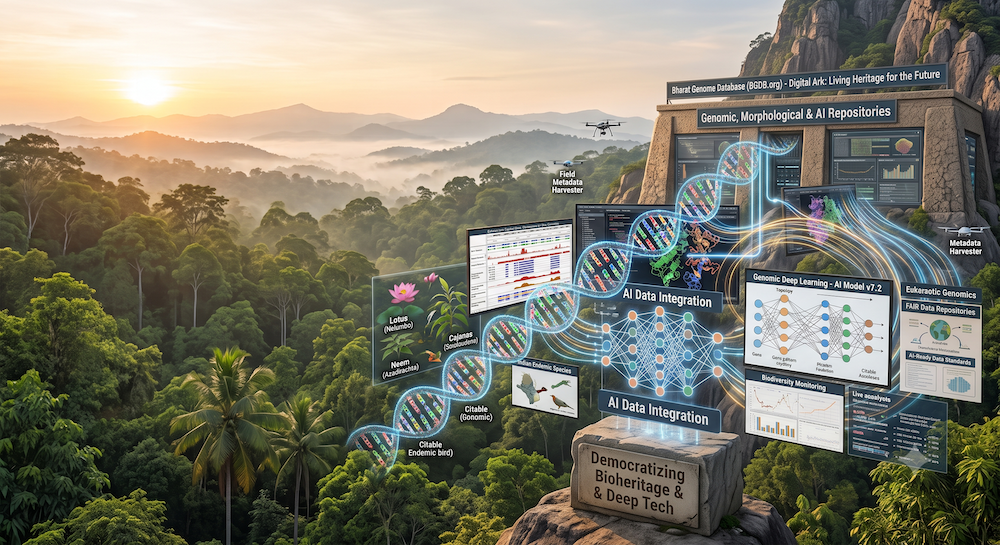
The explosion of long-read sequencing technologies has democratized whole-genome sequencing across the globe. Researchers can now assemble near-complete, chromosome-scale eukaryotic genomes from non-model organisms in a matter of days. However, sequencing an assembly is merely the first step: raw nucleotide sequences reveal biological insights only when accompanied by precise structural and functional gene annotations.
For non-model plants, endemic species, and complex eukaryotic lineages, annotation remains one of the steepest computational bottlenecks in modern genomics. At the Bharat Genome Database (BGDB.org), we developed the VEDA (Versatile Engine for Data Annotation) pipeline—an automated, high-throughput annotation framework engineered specifically to resolve complex eukaryotic gene architectures and accelerate biodiversity conservation.
1. The Challenge of Annotating Eukaryotic Genomes
Unlike prokaryotic genomes with compact, continuous reading frames, eukaryotic genomes present unique computational and structural hurdles:
- Massive Repeat Landscapes: Complex eukaryotic and plant genomes are often dominated by transposable elements (TEs), tandem repeats, and retrotransposons that confuse standard gene prediction models.
- Complex Exon-Intron Architectures: Large introns, non-canonical splice junctions, and pervasive alternative splicing require high-confidence evidence alignment.
- Lineage-Specific Adaptations: Standard predictive models trained on model organisms (like Arabidopsis thaliana or Drosophila) often fail when predicting specialized gene families, secondary metabolite pathways, and non-canonical enzymes in endemic wild flora.
2. Architecture of the VEDA Pipeline
The VEDA Pipeline unifies structural discovery, homology mapping, and machine learning models into a streamlined, automated workflow:
- Repeat Profiling & Soft-Masking: Identifies known and de novo repeat elements across the assembly to prevent false-positive gene calls without disrupting coding potential.
- Hybrid Evidence Integration: Combines ab initio gene prediction models, transcriptomic evidence (RNA-Seq, Iso-Seq), and protein homology data from curated plant and eukaryotic databases.
- Structural & Functional Gene Resolution: Accurately defines exon-intron boundaries, resolves complex gene clusters, and predicts functional domains, GO terms, and metabolic pathway associations.
- FAIR Standardized Outputs: Outputs standardized GFF3, FASTA, and functional annotation tables ready for direct downstream comparative multi-omics and browser visualization.
3. Powering Biodiversity Conservation and the BioHeritage Program
Accurate genome annotation is the cornerstone of conservation genomics and functional bioprospecting. Under the BioHeritage Program at the Sivasakthi Science Foundation, the VEDA pipeline serves as the primary computational backbone for the Adopt-a-Genome Campaign.
By standardizing and automating high-throughput eukaryotic annotations, VEDA allows researchers to:
- Catalog Gene Family Expansions: Identify adaptive genes associated with drought resilience, pathogen resistance, and secondary metabolite production in native subcontinent flora.
- Protect Living Heritage: Provide researchers, breeders, and conservationists with actionable digital blueprints for endangered native species before habitats are lost.
- Empower Open Science: Feed high-resolution annotations directly into BGDB’s browser-native tools like JBrowse 2, IGV, and BLAST.
Explore VEDA on BGDB.org
- Inspect Annotated Assemblies: Browse curated plant genomes annotated via our pipelines, including Nelumbo nucifera (Lotus), Cocos nucifera (Coconut), Azadirachta indica (Neem), and Santalum album (Sandalwood).
- Explore Tools & Resources: Access integrated comparative multi-omics resources and visualization platforms.
- Collaborate: Contact the computational genomics team at research@bgdb.org to integrate VEDA into your genome assembly and annotation workflows!